
In the fast-paced retail and consumer goods sector, tra […]
In the fast-paced retail and consumer goods sector, traditional financial planning tools can no longer keep pace with market volatility. Rapid omnichannel expansion, fluctuating supply chain lead times, compressed operating margins, and intricate promotional mechanics have exposed the critical limits of static spreadsheets and rigid ERP reporting modules. Today, relying on manual data consolidation across store networks is not merely an operational bottleneck; it is a direct threat to bottom-line profitability.
To navigate this complexity and drive resilient growth, Chief Financial Officers (CFOs) and finance leaders are shifting toward modern retail budgeting software. Built as an integral core of cloud-native enterprise performance management software, these advanced platforms replace manual data assembly with dynamic, driver-led intelligence.
When evaluating modern financial solutions, retail finance teams must look beyond basic general ledger accounting. Here are the five essential features required to transform retail budgeting and forecasting from a tedious administrative chore into a strategic growth driver.

1. Driver-Based Planning and Operational Modeling
Traditional retail budgets frequently rely on top-down percentage adjustments applied uniformly across store categories or product lines. Modern retail budgeting software replaces this outdated practice with driver-based planning, directly linking operational variables to P&L outcomes.
- Operational Connectors: Connect store foot traffic, conversion rates, average basket size, markdown cadences, and supplier lead times straight into revenue, inventory, and cost projections.
- Dynamic Automated Recalculations: When key variables shift, such as a sudden surge in raw material prices or freight rates, the underlying financial models automatically update across all stores and divisions, eliminating manual formula rebuilding.
By grounding retail financial planning in real-world operational drivers, finance leaders gain the agility needed to forecast accurate cash flows and protect store margins in real time.
2. Granular SKU and Channel Store Profitability Analysis
Retail success is governed by micro-margins across thousands of stock-keeping units (SKUs) and fragmented sales channels. High-level financial summaries mask profit leakage by averaging performance across high-margin and underperforming locations.
- Multi-Dimensional Visibility: Analyze revenue, cost of goods sold (COGS), and operating margins down to the individual SKU, store location, e-commerce storefront, and wholesale channel.
- Complex Cost Allocation: Seamlessly distribute shared operational overhead, including trade promotions, cooperative advertising, last-mile logistics, and store occupancy fees, to reveal true net store profitability analysis.
Evaluating granular profitability enables retail executives to identify profit-draining SKUs, reallocate marketing budgets to high-performing channels, and optimize product mixes with confidence.
3. Continuous Rolling Forecasts and What-If Scenario Simulation
Annual budget plans anchored to fixed fiscal calendars become obsolete shortly after approval in volatile retail environments. Forward-looking finance teams require rolling forecast software that continuously adjusts to real-time market realities.
- Agile Rolling Forecast Architecture: Transition from rigid, one-time annual budgets to continuous 12-to-24-month rolling forecasts that automatically absorb actual sales performance and point-of-sale (POS) data.
- What-If Scenario Simulation: Instantly model multi-variable market shocks, including sudden promotional discounting wars, supply chain disruptions, or consumer demand drops, to evaluate cash flow resilience before making major capital commitments.
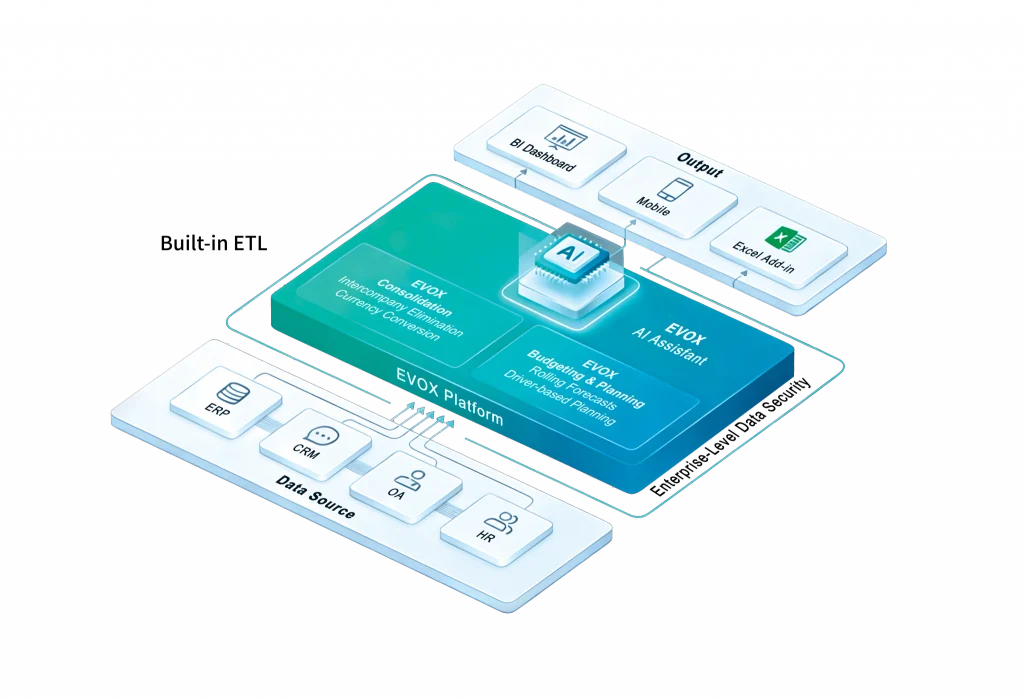
4. Unified Data Architecture for Cross-Functional Collaboration
Fragmented data spread across regional spreadsheets creates conflicting versions of the truth and leads to costly reconciliation delays between corporate finance, merchandising, and supply chain management.
- Single Source of Truth: Centralize sales forecasts, inventory levels, procurement commitments, and general ledger data within a single, cloud-based platform.
- Seamless Enterprise Connectivity: Integrate smoothly with existing Enterprise Resource Planning (ERP) systems, POS networks, and Master Data Management (MDM) architectures to eliminate manual data wrangling.
Aligning cross-functional teams around a shared data foundation ensures that commercial strategies, inventory purchasing, and financial targets remain perfectly synchronized.
5. Automated Workflows, Governance, and Accelerated Planning Cycles
Budget compilation across hundreds of retail stores, regional buyers, and category managers typically involves endless email chains and disconnected files, introducing severe error risks and version chaos.
- Structured Approval Workflows: Implement automated submission paths, granular role-based permissions, and complete audit trails to track who changed what data and when.
- Accelerated Cycle Times: Drastically reduce budgeting and re-forecasting cycles from months down to mere days or hours, freeing FP&A professionals from spreadsheet assembly to focus on strategic advisory.
How EVOX Enterprise Performance Management Software Delivers Modern Retail Budgeting
For enterprise retail organizations navigating market disruption, the EVOX Enterprise Performance Management (EPM) platform delivers these essential capabilities within a unified, cloud-native architecture.
By unifying high-performance driver-based models, granular SKU-level margin visibility, continuous rolling forecasting, and automated consolidation workflows, EVOX eliminates spreadsheet friction and empowers retail CFOs with complete financial clarity and control.
- Shorten Consolidation Cycles: Reduce multi-store budget consolidation and monthly reporting from weeks to hours.
- Protect Operating Margins: Simulate promotional discount impacts and supply chain cost fluctuations before launching campaigns.
- Drive Enterprise Alignment: Connect commercial merchandising, store operations, and FP&A under a transparent, auditable platform.
Frequently Asked Questions (FAQ)
What is retail budgeting software?
Retail budgeting software is a specialized enterprise financial planning platform designed to model complex retail operations, including multi-store networks, SKU-level profitability, supply chain drivers, and promotional dynamics, replacing static spreadsheets with dynamic, automated forecasting.
Why is driver-based planning essential for retail financial planning?
Driver-based planning connects real-world operational metrics (such as store foot traffic, conversion rates, and supplier lead times) directly to financial metrics. When operational variables change, financial models automatically update, enabling highly accurate and agile budgeting.
How does retail budgeting software improve store profitability analysis?
Unlike generic accounting tools, dedicated retail planning software accurately allocates multi-dimensional costs, such as logistics, channel fees, occupancy, and promotional discounts, down to individual store locations and SKUs, exposing hidden profit leaks across channels.
How do rolling forecasts benefit retail finance teams during market volatility?
Rolling forecasts allow retail organizations to extend their planning horizon continuously beyond fixed annual budgets. By constantly updating forecasts with actual POS and market data, finance leaders can model scenarios and adjust inventory and cash flow plans proactively.
See it in your environment
Take the next step with EVOX
Explore how connected planning, consolidation, and performance management can support your priorities.
Start a conversation