
Operating a multi-store and multi-region retail enterpr […]
Operating a multi-store and multi-region retail enterprise is an exercise in complex operational orchestration. As retail organizations expand across geographic boundaries, digital channels, and diverse store formats, including flagship urban centers to compact convenience outlets, financial management scales exponentially in difficulty. Managing regional pricing variations, localized marketing campaigns, complex supply chains, and multi-entity consolidations using disconnected spreadsheets or legacy software creates administrative friction, data silos, and critical strategic blind spots.
To maintain financial control and capture profitable growth across widespread operations, Chief Financial Officers and finance leaders are modernizing their financial stack. Modern retail financial planning requires an integrated Enterprise Performance Management (EPM) platform engineered specifically for multi-unit complexity. By transitioning from static spreadsheets to dedicated retail planning software, forward-thinking retail chains are replacing operational chaos with centralized governance, real-time visibility, and localized agility.

The Hidden Bottlenecks of Legacy Multi-Store Planning
1. Decentralized Data Chaos in Multi-Store Planning
In traditional multi-store planning, regional managers, franchise directors, and category buyers maintain independent Excel workbooks. When corporate finance attempts to aggregate dozens of disconnected files, version control collapses. Finance teams spend weeks reconciling broken formulas and conflicting figures rather than analyzing business performance.
2. Multi-Entity and Multi-Currency Consolidation Friction
Cross-border and multi-region retail operations require complex accounting for intercompany transactions, local tax variations, and currency fluctuations. Legacy tools struggle to automate intercompany eliminations and statutory consolidations, dragging out month-end close cycles and delaying executive decision-making.
3. Surface-Level Performance Visibility and Hidden Profit Leaks
High-level financial rollups often obscure store-level and SKU-level operational realities. Without granular store profitability analysis, corporate leaders cannot easily detect margin erosion caused by localized discounting, rising regional logistics costs, or underperforming product categories.
4. Rigid Annual Calendars vs. Market Volatility
Static annual budgets quickly become obsolete in volatile retail environments. Fixed planning calendars cannot adapt to sudden shifts in consumer demand, localized supply chain bottlenecks, or regional economic fluctuations, leaving retail leaders unprepared for market shocks.
Scaling Control with EVOX Retail Financial Planning
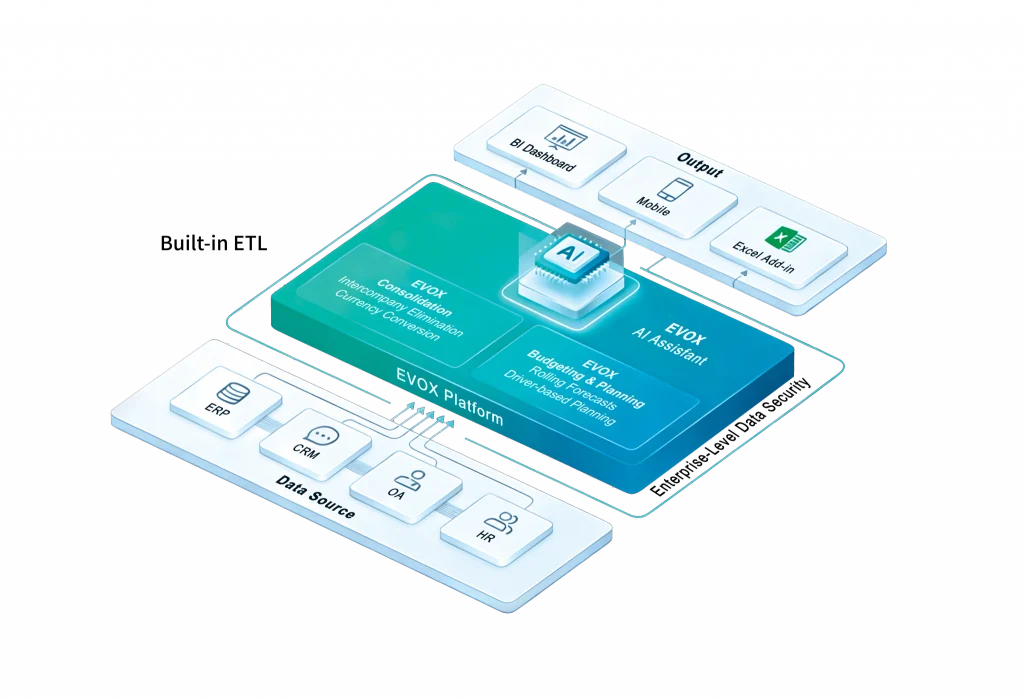
Engineered on an enterprise-grade performance management platform, EVOX transforms fragmented retail planning into a unified, intelligent ecosystem. EVOX provides CFOs and FP&A teams with absolute visibility and agile control across complex retail networks.
Centralized Governance with Localized Agility
EVOX bridges corporate oversight and field-level execution. Corporate finance establishes standardized enterprise-wide financial models, while empowering store directors and regional leads to input localized operational drivers. This ensures strict corporate governance without sacrificing regional responsiveness.
Automated Multi-Entity Consolidation and Foreign Exchange
For chain store enterprises operating across multiple legal entities and geographic territories, EVOX automates intercompany eliminations, currency translations, and statutory consolidations. This dramatically accelerates group-level close cycles and ensures compliance across diverse jurisdictions.
Tailored Driver-Based Planning for Diverse Store Formats
Different retail formats, such as supermarkets, boutique stores, or convenience outlets, possess distinct cost structures and revenue drivers. EVOX supports flexible driver based planning, linking variables like store square footage, foot traffic, labor hours, and local lease terms directly to master financial forecasts.
Continuous Rolling Forecasts and Scenario Analysis
EVOX enables finance teams to move from static annual budgets to dynamic rolling forecast software. Financial leaders can run localized what-if scenario simulations, modeling the margin impact of regional price adjustments, inventory disruptions, or store expansion plans in real time.
Proven Enterprise Results: Industry Proof Points
Global retail and enterprise leaders rely on EVOX to streamline financial management and drive profitable scale:
- LAWSON China (6,300+ Convenience Stores): Achieved 95% process automation in budgeting, reduced planning cycle times by 60%, and accelerated resource reallocation by 3X across its nationwide store footprint.
- Master Kong Beverage (6,000+ Channels & 2,000+ Sales Units): Compressed group-wide budgeting cycles from 1 month to under 1 week, enabling precise profitability analysis down to the individual SKU and channel level.
- Mixue Ice Cream & Tea (Global F&B Retail Chain): Boosted forecast accuracy to 98%, halved planning cycle times, and unified budget centers across global business units and logistics networks.
Frequently Asked Questions (FAQ)
What is retail financial planning?
Retail financial planning is the integrated process of budgeting, forecasting, and performance management across store networks, product categories, and sales channels to optimize cash flow, margin control, and store profitability.
Why do multi-store chains need dedicated retail planning software?
Generic spreadsheets fail under multi-unit complexity, causing version control issues, delayed consolidations, and a lack of store-level margin visibility. Dedicated retail planning software automates data integration, cost allocations, and rolling forecasts across all store locations.
How does EVOX improve store profitability analysis?
EVOX allocates complex shared overhead, including logistics, trade promotions, and occupancy fees, down to individual store locations and SKUs, giving finance teams a clear view of true net margins.
How does driver-based planning benefit multi-region retail operations?
Driver-based planning connects operational metrics (such as foot traffic, sales per square foot, and labor hours) directly to financial models, enabling accurate, automated recalculations when market conditions change.
See it in your environment
Take the next step with EVOX
Explore how connected planning, consolidation, and performance management can support your priorities.
Start a conversation